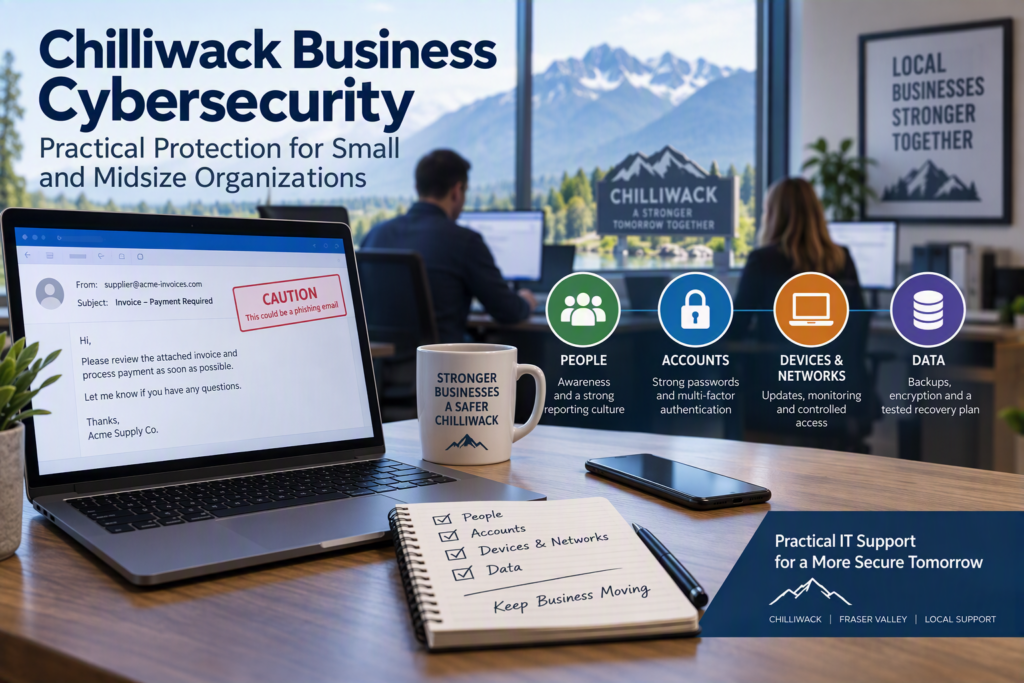
A single convincing email can bring a busy office to a standstill. An invoice appears to come from a trusted supplier, a staff member enters their Microsoft 365 password, and an outsider now has a potential path into email, files, contacts, and financial information. For Chilliwack business cybersecurity, the real objective is not buying the most security tools. It is building practical protection that helps your organization continue serving clients when someone tries to get in.
Small and midsize organizations are frequently targeted because attackers may expect limited internal IT resources, busy employees, and security gaps that have gone unnoticed for years. A legal office, clinic, nonprofit, construction company, or professional practice may not see itself as a target. Yet every organization holds something valuable: payment details, personal information, email access, confidential records, or the ability to send a believable message to someone else.
The good news is that effective business cybersecurity does not require turning your team into cybersecurity experts. It requires clear priorities, sensible safeguards, employee awareness, and a support partner that can respond quickly when something does not look right.
What Chilliwack Business Cybersecurity Should Protect
Cybersecurity is often described as a technical issue. For business owners and managers, it is also an operational issue. Strong cybersecurity helps protect your ability to answer phones, access client files, process payroll, book appointments, communicate with customers, and meet business commitments.
Start by identifying the systems your organization cannot function without. For many offices, that means email, Microsoft 365 files, accounting software, line-of-business applications, internet service, workstations, and phones. In a healthcare setting, patient information and access to clinical systems may be the priority. In a nonprofit, donor records and service-delivery files may matter most.
This exercise changes the conversation. Rather than asking, “What security product should we buy?” you can ask, “What would happen if this system were unavailable or exposed for three days?” The answer helps determine where to invest first and where additional cybersecurity protection may be needed.
A useful cybersecurity plan protects four connected areas:
People, who need to recognize suspicious requests and know how to report them.
Accounts, which need strong passwords, multi-factor authentication, and appropriate access levels.
Devices and networks, which need updates, security monitoring, and controlled access.
Data, which needs reliable backups, encryption where appropriate, and a recovery plan that has been tested.
No single cybersecurity measure is enough. Multi-factor authentication will not fix an unpatched server, and backups will not prevent a fraudulent payment request. Layered protection gives a business more than one opportunity to stop an incident before it becomes a crisis.
The Cybersecurity Risks Local Organizations Actually Face
The most damaging cybersecurity threats are not always the most technical. Phishing remains one of the most common entry points because it targets people during a normal workday. Messages may impersonate a manager, a vendor, a bank, a shipping company, or Microsoft. They often create urgency: a password is expiring, a payment needs approval, or a document must be reviewed immediately.
Business email compromise deserves special attention. In this type of fraud, an attacker gains access to an email account or convincingly impersonates it. They may watch conversations quietly, then send altered banking details or request an urgent transfer at the right moment. A business can have antivirus software and still lose money if its payment process relies on one person acting quickly from an email.
Ransomware is another serious concern for businesses of every size. Attackers may encrypt files, steal data, and threaten to publish it if a payment is not made. Effective ransomware protection depends on more than having a backup subscription. Backups must be separated from everyday systems, monitored for success, and periodically tested to confirm that files can actually be restored.
There is also the quieter risk of weak access control. Former employees may retain access to email or cloud files. Staff may share a common password for convenience. An administrator account may be used for everyday work. These practices are understandable in a busy office, but they make it harder to identify suspicious activity and contain a security problem.
Put the Cybersecurity Basics in Place Before Adding Complexity
The strongest first steps are often straightforward. Every email, cloud application, financial platform, and remote-access system should use multi-factor authentication. This means a password alone is not enough to sign in. An attacker who steals credentials faces an additional barrier.
Next, keep computers, servers, firewalls, and applications updated. Delayed updates create openings that criminals actively look for. The right timing depends on the system. Some updates can be installed automatically, while a critical business application may need to be scheduled after hours and verified carefully. The goal is not reckless change. It is a dependable IT security process that does not leave known vulnerabilities open indefinitely.
Endpoint protection and monitoring should cover every business device, including laptops that leave the office. A well-managed security service can detect suspicious behavior, isolate a device when needed, and help investigate what happened. This is particularly valuable for small and midsize organizations without an internal IT department watching security alerts throughout the day.
Access should also match each person’s role. Reception staff do not need the same permissions as an accounting manager, and a temporary contractor should not receive permanent access to every shared folder. When someone changes roles or leaves, access should be reviewed promptly. Strong access control and account management are important parts of small business cybersecurity just as they are for larger organizations.
Make Employees Part of Your Cybersecurity Defense
Security awareness training works best when it is practical and respectful. Employees do not need a lecture on technical terminology. They need to recognize the situations they are likely to encounter and feel comfortable asking for help before they click.
Teach teams to pause when a message requests a password, payment, gift cards, banking changes, confidential files, or an unexpected login. A phone call to a known number can verify a financial request. A quick report to IT can prevent a suspicious attachment from becoming a larger security issue.
Regular short training sessions and simulated phishing exercises can help, but they should not be used to embarrass people. The point is to build a strong reporting culture. Employees who report a questionable email right away give your organization time to protect others who received the same message.
For businesses in Chilliwack and throughout the Fraser Valley, cybersecurity awareness should be an ongoing process rather than a once-a-year training exercise. New scams, impersonation techniques, and phishing tactics continue to evolve, so employees need simple guidance they can apply during everyday work.
Backups Are a Cybersecurity Recovery Plan, Not a Checkbox
Many businesses assume their cloud files are fully protected because they use Microsoft 365 or another hosted platform. Those services provide valuable resilience, but they do not replace a business-owned backup and disaster recovery strategy. Accidental deletion, malicious changes, compromised accounts, and retention limits can all affect what is available later.
A sound backup approach keeps more than one copy of essential data, with at least one protected from normal network access. It also defines how quickly systems need to be restored. Recovering a single file is different from rebuilding an entire server or bringing a clinic back online after ransomware.
Ask direct questions: When was the last successful restore test? Who has authority to begin recovery? Where are the instructions if the primary contact is unavailable? These details matter most on the day when normal systems are no longer available.
Regularly tested backups can make the difference between a manageable recovery and a prolonged business disruption. Backup monitoring should therefore be treated as part of your overall business continuity and cybersecurity plan.
Prepare for the First Hour of a Cybersecurity Incident
Even organizations with good security controls can face a cybersecurity incident. Fast, calm action can help limit damage. Staff should know who to contact if they suspect an account has been compromised, a device displays a ransomware message, or an unusual payment request has been approved.
The first response may involve disconnecting a device from the network, securing affected accounts, preserving evidence, checking whether other systems are involved, and notifying the right internal leaders. Do not assume deleting an email or restarting a computer has solved the problem. It can remove useful information while leaving the underlying access in place.
This is where responsive, plain-language IT support and cybersecurity services can make a practical difference. A managed IT partner can help assess the situation, coordinate recovery, and explain choices without adding panic. Myriad Technologies works with Fraser Valley organizations to build preventative maintenance, security, backup, and response practices around how their teams actually work.
Build a Cybersecurity Strategy That Fits Your Business
Cybersecurity should fit the size, budget, and responsibilities of your organization. A small office does not need to copy an enterprise security program, but it does need clear safeguards for its most important information and operations.
Effective Chilliwack business cybersecurity starts with understanding what you need to protect, identifying the risks that could interrupt your work, and putting practical controls in place. That may include multi-factor authentication, employee security awareness, endpoint protection, access control, Microsoft 365 security, backup monitoring, patch management, and an incident response plan.
Start with the risks that could interrupt your work tomorrow, assign ownership, and keep improving from there. The best time to make a cybersecurity response plan understandable is well before anyone needs to use it.