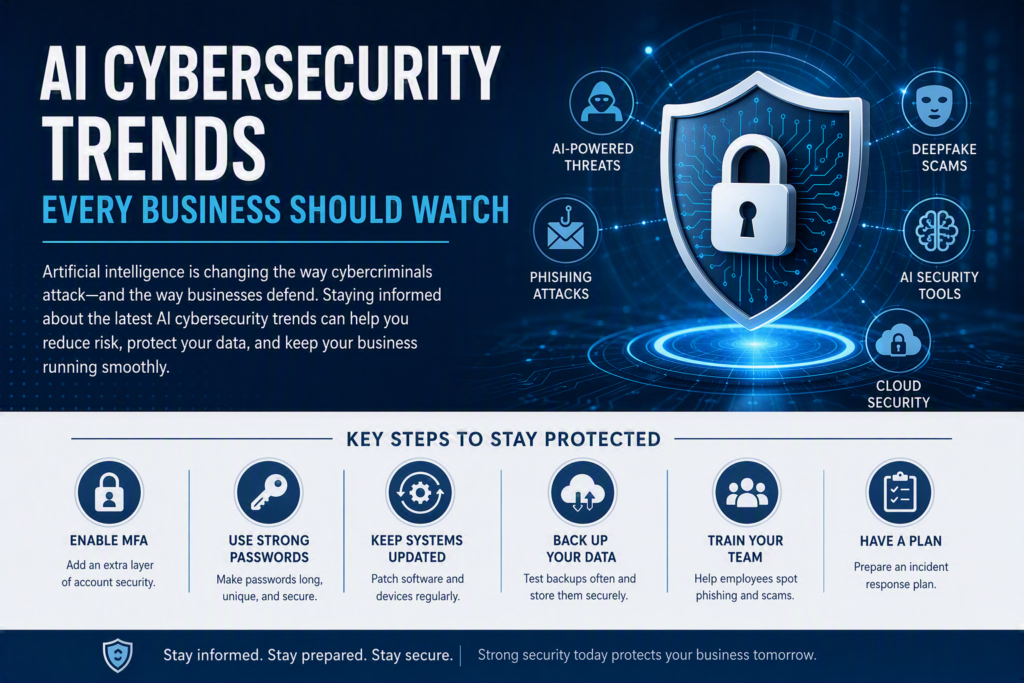
Artificial intelligence is rapidly changing the cybersecurity landscape. While AI helps businesses improve efficiency and strengthen security, it is also giving cybercriminals new tools to create more convincing attacks. Understanding the latest AI cybersecurity trends can help your organization stay ahead of emerging threats and better protect its data, employees, and customers.
AI-Powered Phishing Attacks Are Becoming More Sophisticated
Phishing remains one of the most common cyber threats, but AI is making these scams much harder to spot. Attackers can use AI to create realistic emails that mimic executives, suppliers, and trusted contacts, often without the spelling errors and poor grammar that once revealed a scam.
These messages may request payment approvals, password resets, or sensitive company information. Because they look legitimate, businesses should train employees to verify unusual requests and avoid relying solely on email communications for important decisions.
Deepfake Voice and Video Scams Are on the Rise
Another growing AI cybersecurity trend is the use of deepfake technology. Cybercriminals can now create convincing voice recordings or videos that appear to come from company leaders or trusted partners.
An employee may receive a call that sounds exactly like their manager requesting an urgent transfer of funds or confidential information. To reduce risk, organizations should establish clear approval processes and require secondary verification for financial transactions and sensitive requests.
AI Is Improving Cybersecurity Defenses
While attackers are using AI to launch smarter attacks, businesses can also use AI-powered security tools to strengthen their defenses.
Modern cybersecurity platforms use AI and machine learning to detect unusual activity, identify suspicious login attempts, and recognize potential threats before they cause damage. These tools can help organizations respond faster to security incidents and reduce the impact of cyberattacks.
For many small and mid-sized businesses, AI-driven security solutions provide an extra layer of protection that would otherwise require a large internal security team.
Cloud Security and Microsoft 365 Protection
As organizations continue moving to cloud-based services, securing platforms like Microsoft 365 has become more important than ever. AI-powered monitoring can help identify suspicious logins, risky file-sharing activity, and potential data loss.
However, technology alone is not enough. Businesses should also implement strong security practices such as multifactor authentication (MFA), access controls, regular account reviews, and secure backup solutions to protect critical business data.
The Importance of Strong Cybersecurity Fundamentals
Despite advances in AI, many successful cyberattacks still exploit basic security weaknesses. Businesses should focus on proven cybersecurity best practices, including:
- Enabling multifactor authentication (MFA)
- Using strong, unique passwords
- Keeping software and devices updated
- Regularly testing backups
- Limiting unnecessary user access
- Training employees to recognize phishing attempts
These foundational security measures remain some of the most effective ways to defend against both traditional and AI-powered cyber threats.
Creating a Safe Approach to AI
Many businesses are adopting AI tools to improve productivity, automate tasks, and support decision-making. While these tools offer significant benefits, organizations should establish clear guidelines around their use.
Employees should understand what information can and cannot be entered into AI applications. Sensitive data such as customer records, financial information, passwords, and confidential business documents should never be shared with unapproved AI platforms.
A clear AI usage policy can help balance innovation with security and compliance requirements.
Final Thoughts
AI is reshaping the cybersecurity landscape for businesses of all sizes. From AI-generated phishing emails and deepfake scams to smarter threat detection and automated security monitoring, the technology is changing both how attacks happen and how they are prevented.
The businesses that will be best prepared are those that combine strong cybersecurity fundamentals with modern security tools. By staying informed about the latest AI cybersecurity trends, organizations can reduce risk, strengthen resilience, and confidently navigate an increasingly digital world.