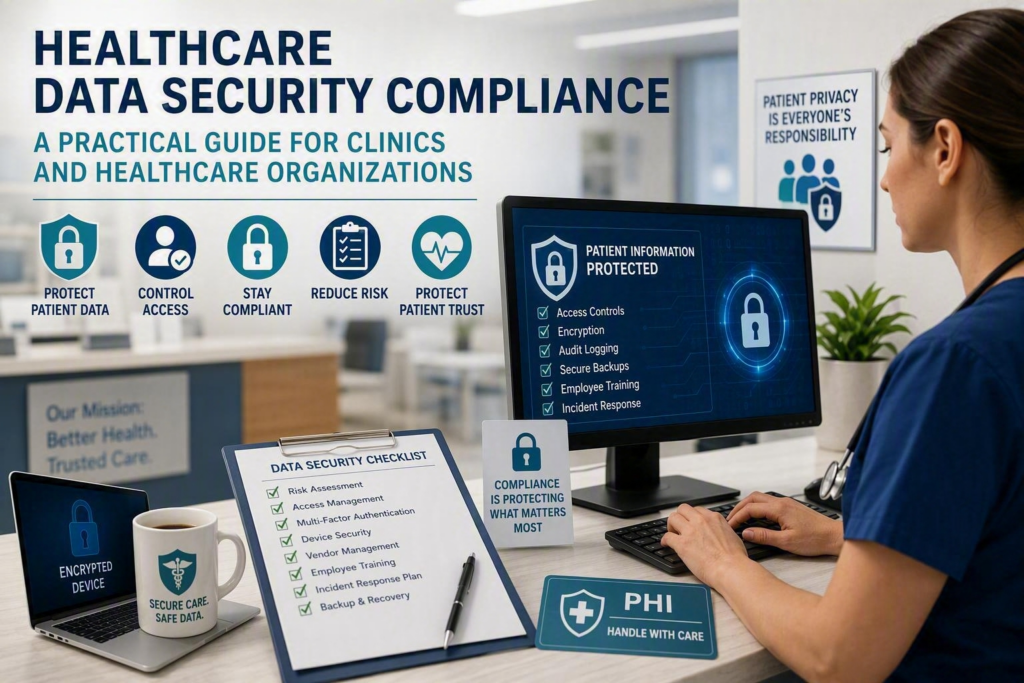
A misplaced laptop, a shared password, or an employee clicking a convincing fake invoice can expose far more than an ordinary business file. For healthcare organizations, the consequences can affect patient privacy, care delivery, finances, reputation, and regulatory compliance at the same time.
This healthcare data security compliance guide explains the practical safeguards that help clinics, pharmacies, medical offices, and other healthcare organizations protect patient information without making everyday work unnecessarily difficult.
From access controls and multifactor authentication to secure devices, vendor management, employee training, and incident response, effective healthcare cybersecurity starts with understanding how patient information moves through your organization.
Start With the Patient Information You Actually Handle
Effective healthcare data security begins with visibility.
You cannot properly protect patient information if nobody can clearly explain where it is stored, who can access it, or how it moves outside the organization.
Start by mapping the flow of protected health information (PHI) throughout your organization.
PHI can include much more than information stored inside an electronic health record system. It may also appear in:
Appointment emails
Scanned referrals
Billing records
Voice messages
Cloud storage
Text messages
Online intake forms
Paper documents
Shared files
Patient communications
For example, a receptionist may receive patient information through an online form. A clinician may access a patient chart from home. A billing company may download reports to process claims.
Every one of these activities is part of your healthcare data security environment.
Understand Your Healthcare Compliance Requirements
For US healthcare organizations, HIPAA is often a key starting point. The HIPAA Security Rule requires appropriate administrative, physical, and technical safeguards for electronic protected health information.
However, healthcare compliance is not identical for every organization.
A single-provider medical clinic and a multi-location healthcare organization can have very different risks, technology environments, staffing levels, and budgets. The important thing is to identify your risks, implement appropriate safeguards, document your decisions, and regularly review whether those safeguards remain effective.
State privacy laws, payer requirements, professional standards, contracts, and agreements with business partners may create additional obligations.
Healthcare data security compliance should therefore be treated as an ongoing process rather than a binder that is reviewed once a year.
Make Risk Analysis the Foundation of Your Healthcare Cybersecurity Program
A formal healthcare cybersecurity risk assessment is one of the most useful exercises a healthcare organization can complete.
A good risk analysis asks straightforward questions:
What could happen to patient information?
How likely is the risk?
What would the impact be?
What safeguards are already in place?
What additional protections are needed?
Who is responsible for addressing the risk?
The answers should reflect how your organization actually operates.
For example, a small clinic that relies heavily on email and cloud applications may face a significant risk of account takeover. A pharmacy may depend on connected dispensing systems, payment terminals, and specialized devices that require careful network security. A mobile healthcare team may need secure access to patient information from laptops and smartphones outside the office.
Document your findings and turn them into an action plan.
High-risk issues should have a responsible person and a target completion date. Common priorities include:
Unsupported computers
Weak or reused passwords
Excessive user permissions
Unencrypted devices
Missing or unreliable backups
Outdated software
Poorly secured Wi-Fi
Vendors with access to PHI
Missing or outdated agreements with service providers
Risk analysis should not be a one-time exercise.
Review your security risks after a ransomware incident, office move, new software implementation, merger, staffing change, or major change in remote work.
A new patient intake platform, for example, may improve the patient experience while also creating a new vendor relationship and a new flow of patient information that needs to be assessed.
Build Healthcare Security Safeguards Around Real-World Work
The best healthcare security strategy is one that employees can actually follow when they are busy.
If security procedures are too complicated, employees may create workarounds that introduce additional risks.
Control Access to Patient Information
Every employee should have their own business account.
Shared logins make it difficult to determine who accessed a patient record and make it much harder to remove access when an employee leaves.
Use role-based access whenever possible. Give employees only the information and systems they need to perform their jobs, then review permissions regularly.
Multi-factor authentication should protect email, remote access, cloud storage, administrative accounts, and systems containing PHI.
A password alone is no longer enough.
MFA can involve an authenticator application, phone approval, security key, or another approved authentication factor. The small amount of extra time required is far less disruptive than recovering a compromised healthcare account.
Your organization should also have a clear employee offboarding process.
When an employee or contractor leaves:
Disable their accounts promptly
Remove access to business applications
Recover organization-owned devices
Transfer important files and account ownership
Review shared accounts
Remove access to vendor portals
Fast access removal reduces the chance that former employees or compromised accounts can continue accessing sensitive information.
Keep Healthcare Devices and Networks Secure
Healthcare organizations depend on technology that must remain available. However, keeping systems available should not mean leaving them unprotected.
Apply operating system and application updates on a managed schedule, replace unsupported hardware, and protect computers with business-grade endpoint security.
Laptops and mobile devices that store or access PHI should also use encryption.
If a laptop is lost from a vehicle or a phone is left in a public location, encryption can help prevent the physical loss of the device from becoming a data exposure.
Your network requires the same level of attention.
Use secure Wi-Fi encryption, separate guest networks from business systems, and limit unnecessary connections between workstations, clinical devices, and administrative systems.
Network segmentation can be particularly valuable in healthcare environments where specialized equipment cannot be updated as frequently as standard computers.
Separating systems can help limit the damage if one device is compromised.
Improve Healthcare Email Security Without Slowing Down Your Team
Email remains one of the most common ways cybercriminals target healthcare organizations.
Phishing and fraud can lead to stolen credentials, malware infections, financial losses, and accidental disclosure of patient information.
Use email filtering and security tools to reduce malicious messages, but do not rely on technology alone.
Employees should know how to recognize suspicious:
Payment requests
Password-reset messages
Attachment requests
Login notifications
Unexpected links
Urgent requests from executives
Messages appearing to come from vendors or patients
For communications containing PHI, use a method approved by your organization and appropriate for the sensitivity of the information.
The correct approach depends on the systems involved, the recipient’s access, and your organization’s policies.
Convenience is important in healthcare, particularly when coordinating patient care. However, convenience should always be balanced with documented security safeguards and clear employee guidance.
Manage Healthcare Vendors as Part of Your Compliance Program
Healthcare organizations often depend on outside providers for services such as:
Medical billing
Transcription
Cloud storage
IT support
Data backup
Patient communication
Scheduling
Telehealth
Software platforms
Document management
If a vendor creates, receives, maintains, or transmits PHI on behalf of your organization, it may qualify as a business associate under HIPAA.
That relationship requires more than a vendor saying that its systems are secure.
Healthcare organizations should understand how their vendors handle patient information and maintain appropriate agreements when required.
Ask practical questions such as:
Where is patient data stored?
Who can access it?
Is the data encrypted?
How are backups protected?
How does the vendor detect security incidents?
How quickly will the vendor notify your organization of an incident?
What happens to the data if the contract ends?
Which subcontractors can access the information?
A Business Associate Agreement (BAA) is important when required, but a signed agreement is not a replacement for vendor due diligence.
The agreement defines responsibilities between organizations. It does not automatically make an unsuitable technology platform secure.
Prepare for a Healthcare Cybersecurity Incident
A security incident does not always begin with a dramatic ransomware message.
It could start with:
An employee sending a patient record to the wrong email address
A stolen phone
A compromised cloud account
A phishing email
An unauthorized login
Malware on a workstation
A lost laptop
The difference between a contained incident and a major disruption often comes down to preparation.
Create a simple healthcare incident response plan that tells employees who to contact and what they should do first.
Staff should know not to:
Delete suspicious emails
Continue using a potentially compromised account
Repeatedly reboot an affected computer
Attempt to investigate a serious incident themselves
Hide an accidental disclosure
Early reporting gives your IT team or managed IT provider a better opportunity to preserve evidence, isolate affected systems, secure accounts, and protect other parts of the environment.
Your incident response plan should address:
Technical response
Patient care continuity
Internal communication
External communication
Legal considerations
Insurance requirements
Vendor coordination
Regulatory review
Identify who can make decisions if systems become unavailable and how your organization will continue serving patients during an outage.
Make Backups Part of Your Healthcare Recovery Strategy
Backups are an important part of healthcare business continuity, but only if they can actually be restored.
Maintain protected backups and keep at least one backup copy isolated from your primary network. Test restoration regularly so your team knows the backups work before an emergency happens.
A backup that has never been tested is an assumption, not a reliable recovery strategy.
Train Healthcare Employees to Make Safer Security Decisions
Annual cybersecurity training is useful, but security awareness should not be limited to one presentation every year.
Employees should understand:
Why patient information is valuable
How phishing attacks work
How to recognize suspicious login requests
When to use approved communication systems
How to handle sensitive information
How to report a security concern
What to do if they make a mistake
Short, regular training tied to real situations can be more effective than a long annual presentation.
For example, discuss a recent phishing technique, review how to verify someone requesting a password reset, or explain the correct process for taking patient information home.
The goal is not to turn clinicians, receptionists, and administrators into cybersecurity experts.
The goal is to help them make safer decisions when it matters.
Leadership also plays an important role. When managers follow the same security rules, report suspicious activity, support software updates, and take employee concerns seriously, staff are more likely to view cybersecurity as part of patient care rather than an obstacle to their work.
Turn Healthcare Data Security Compliance Into a Routine
Healthcare data security can feel overwhelming when it is treated as one large project.
Instead, turn it into a repeatable routine:
Review user access
Apply security updates
Test backups
Review vendors
Monitor accounts
Train employees
Assess risks
Document important decisions
Update your incident response plan
A dependable IT partner can help translate technical requirements into practical security processes that fit the size and pace of your healthcare organization.
For clinics, pharmacies, medical offices, and other healthcare organizations, the goal is not simply to check compliance boxes. It is to build a security environment that protects patient information while allowing your team to focus on providing care.
The best next step is a candid review of how patient information moves through your organization.
Start with one workflow. Identify where information is collected, stored, accessed, shared, and deleted. Then find the weakest points and improve them.
Every practical improvement strengthens your healthcare data security and compliance program and helps protect more than information—it helps preserve the trust patients place in your organization.