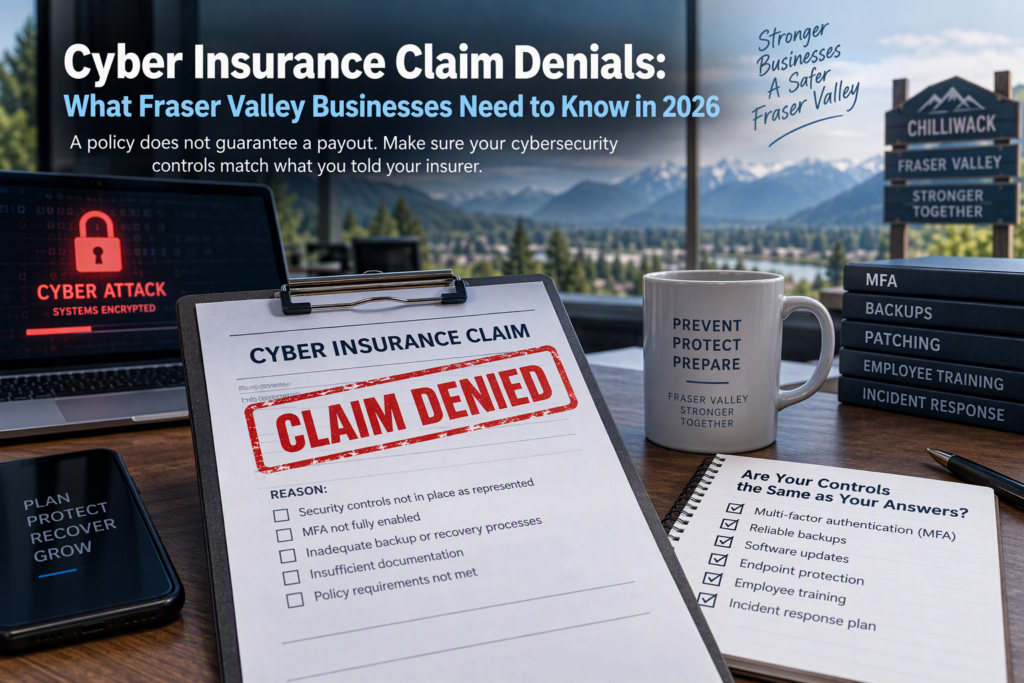
Cyber insurance is designed to help businesses manage the financial impact of a cyberattack. But having a policy does not automatically mean a claim will be paid.
In 2026, businesses are facing increasing scrutiny over the cybersecurity controls they report to insurers. When a ransomware attack, business email compromise, or other cyber incident occurs, insurers may investigate whether the security measures described during the application or renewal process were actually in place and operating as required.
That creates an important question for Chilliwack and Fraser Valley businesses:
Are the cybersecurity controls on your insurance questionnaire the same controls your IT environment actually has today?
A gap between the two can create problems during a cyber insurance claim.
Why Cyber Insurance Requirements Matter in 2026
Cybersecurity threats continue to affect Canadian organizations of all sizes. The Canadian Centre for Cyber Security’s Ransomware Threat Outlook 2025-2027 reports that ransomware incidents affecting Canadian organizations increased in 2024 compared with 2023. The Cyber Centre also reports that 13% of businesses that experienced a cybersecurity incident in its 2023 survey identified ransomware as the method of attack.
The same report highlights the importance of basic cybersecurity practices such as:
Multi-factor authentication (MFA)
Regular software updates
Reliable backups
Phishing awareness
Strong cybersecurity processes
These controls are also increasingly relevant when businesses apply for or renew cyber insurance.
Insurance policies vary, but businesses may be asked about their use of MFA, endpoint protection, backups, access controls, employee training, incident response planning, and other security measures.
The important point is simple: do not assume that checking “yes” on an insurance questionnaire means your work is finished.
Cyber Insurance Claim Denials Can Start With a Security Control Gap
One of the biggest risks businesses face is a difference between what was reported to the insurer and what actually exists in the environment.
For example, a business may state that MFA is enabled throughout the organization. However, MFA could be missing from:
Administrator accounts
Remote access systems
Cloud applications
Third-party vendor accounts
Legacy systems
Contractor accounts
Backup platforms
That does not automatically mean an insurer will deny a claim. The outcome depends on the specific policy language, facts of the incident, representations made during underwriting, and applicable law.
However, a security control that was represented as being in place but was not actually implemented can become an important issue during a claim investigation.
MFA Is One of the Most Important Cyber Insurance Controls
Multi-factor authentication provides an additional layer of protection beyond a password. The Canadian Centre for Cyber Security specifically identifies MFA as a fundamental cybersecurity practice for Canadian organizations.
The challenge is making sure MFA is enabled consistently.
For example, your organization might have MFA enabled for Microsoft 365 but not for a remote access application or an administrative account. An attacker who obtains those credentials may still have a path into the environment.
That is why businesses should review MFA account by account and system by system, rather than assuming one application being protected means the entire organization is protected.
Backups Are Not Enough If You Cannot Recover From Them
Backups are another area businesses should examine carefully.
An organization may have automated backups running every night, but that does not necessarily mean those backups will be useful during a ransomware incident.
Ask:
Are backups isolated from the production network?
Are important backups protected against unauthorized deletion?
Are backup jobs monitored?
Are restores tested regularly?
Is there documented evidence of successful recovery tests?
How quickly could critical systems be restored?
The Canadian Centre for Cyber Security identifies backups alongside MFA and software updates as fundamental cyber hygiene practices.
For insurance purposes, it is also useful to keep documentation showing that these controls are actually being maintained.
A dashboard showing that a backup completed is useful. Evidence that your team has successfully restored data is even more meaningful when evaluating recovery readiness.
Cyber Insurance Applications Should Be Treated Carefully
A cyber insurance questionnaire is not simply paperwork to complete as quickly as possible.
Questions about cybersecurity controls can require input from business owners, management, IT staff, and external IT providers.
Before submitting an application or renewal, review the answers against your current technology environment.
For example:
Insurance questionnaire: MFA is enabled for all privileged accounts.
Reality: MFA is enabled for Microsoft 365 administrators, but an older remote access account still uses a password only.
That discrepancy should be investigated before the questionnaire is finalized.
The same principle applies to backups, endpoint protection, security monitoring, employee training, and incident response plans.
If you are unsure whether a control meets the insurer’s requirements, ask the insurer, broker, or qualified cybersecurity professional for clarification rather than making assumptions.
What Happens After a Cyber Insurance Claim?
When a serious cyber incident occurs, the insurer may investigate the circumstances surrounding the claim.
Depending on the policy and incident, this may involve forensic specialists examining systems, identifying the attack path, determining what happened, and reviewing relevant security controls and records.
This is why documentation matters.
Businesses should maintain evidence such as:
MFA configuration and enrollment records
Backup reports
Backup restoration test results
Endpoint protection status
Patch and update records
Security assessment reports
Employee cybersecurity training records
Incident response plans
Access control reviews
Security policies
Relevant IT service documentation
The goal is not to create paperwork for its own sake. Documentation helps demonstrate what security measures were actually in place and how they were maintained.
Cyber Insurance Does Not Replace Cybersecurity
Cyber insurance should be viewed as one part of a broader risk management strategy.
The Canadian Centre for Cyber Security states that basic cyber hygiene, including MFA, backups, software updates, and awareness of phishing, helps organizations strengthen their cyber readiness.
Insurance can potentially help with certain financial consequences of a covered incident, but it does not prevent the attack from happening.
Your business still needs:
Strong identity and access controls
Secure backups
Endpoint protection
Regular patching
Email security
Employee security awareness
Incident response planning
Ongoing monitoring
A process for reviewing cybersecurity risks
The stronger your underlying security program, the better prepared you are for both an attack and the insurance process that may follow.
Privacy Obligations Still Apply After a Cyberattack
A cyber insurance claim is only one part of the aftermath of a security incident.
If personal information is involved, businesses may also have privacy obligations.
Under PIPEDA, organizations subject to the legislation must report certain breaches involving personal information when there is a real risk of significant harm, notify affected individuals, and maintain records of breaches. The Office of the Privacy Commissioner of Canada states that breach records must be kept for at least two years.
Whether PIPEDA applies to your organization depends on the circumstances and applicable jurisdiction. Businesses should also consider any provincial privacy requirements that may apply to them.
A denied or disputed insurance claim does not remove applicable legal or regulatory obligations.
What Fraser Valley Businesses Should Do Before Their Next Renewal
If your business has cyber insurance, do not wait until renewal time to review your cybersecurity controls.
A practical review can include:
1. Audit MFA
Review every user, administrator, remote access system, cloud application, contractor account, and vendor connection.
Confirm that MFA is enabled where required and remove accounts that are no longer needed.
2. Test Your Backups
Do not rely only on automated backup notifications.
Perform documented restore tests and confirm that critical business data can actually be recovered.
3. Review Your Insurance Questionnaire
Compare every cybersecurity-related answer against your current environment.
If something has changed since your last application, discuss it with your insurance broker or insurer.
4. Document Your Security Controls
Keep records showing that important controls are being implemented and maintained.
This may include backup reports, MFA records, security assessments, training records, and restoration tests.
5. Review Your Incident Response Plan
Your team should know what to do if ransomware, phishing, credential theft, or another serious cyber incident occurs.
The plan should identify who needs to be contacted, how systems should be isolated, and how the business will communicate during an incident.
6. Review Changes With Your IT Provider
Your cybersecurity environment can change throughout the year.
New software, remote access tools, employees, vendors, administrator accounts, and cloud applications can all introduce new risks.
A regular technology and security review can help identify these changes before they become a problem.
How Myriad Technologies Can Help With Cyber Insurance Readiness
For Fraser Valley businesses, preparing for a cyber insurance application should start with understanding what security controls are actually in place.
Myriad Technologies’ cyber insurance requirements guide covers important security considerations businesses should review when preparing for cyber insurance.
A cybersecurity assessment can help identify gaps in areas such as MFA, backups, endpoint security, access controls, patching, and other baseline protections.
The goal is not simply to help a business answer an insurance questionnaire.
It is to help ensure that the answers reflect the organization’s real technology environment.
Prepare for the Claim Before You Need to Make One
Cyber insurance can provide an important layer of financial protection, but the policy is only one part of your cybersecurity strategy.
For Chilliwack and Fraser Valley businesses, the better approach is to review cybersecurity controls regularly, keep evidence of those controls, and make sure insurance applications accurately reflect the current environment.
Do not wait for a ransomware attack to discover that an administrator account was missing MFA or that your backup had never been tested.
Review your controls now. Document what you find. Fix the gaps. And make sure your cyber insurance application matches reality.