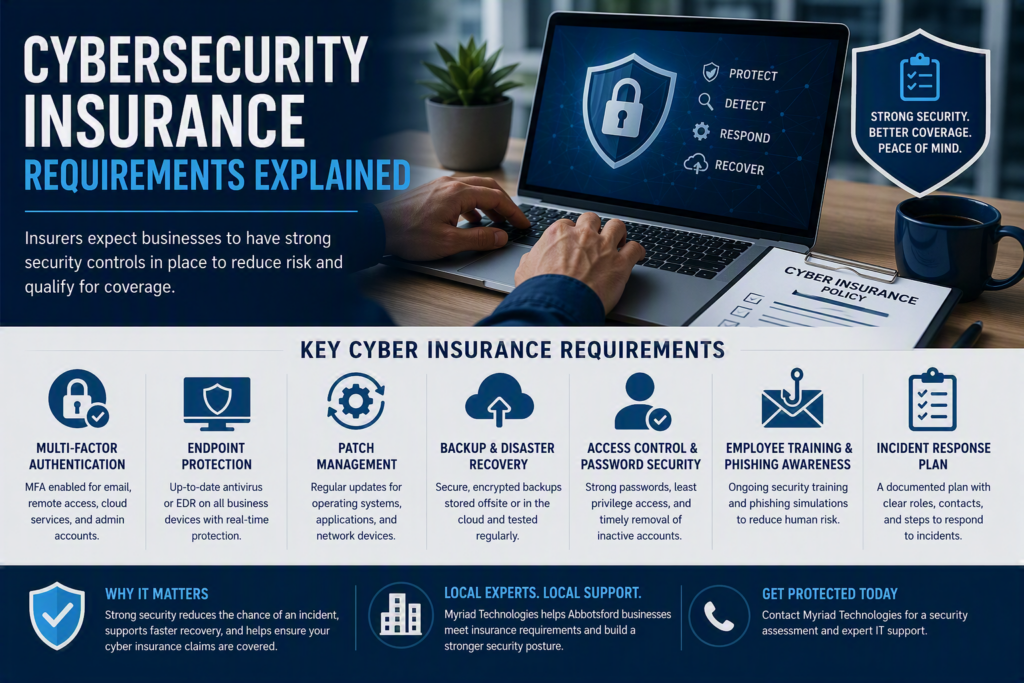
Cyberattacks, ransomware, and business email compromise incidents continue to rise, making cyber insurance an essential part of risk management for many organizations. However, obtaining coverage is no longer as simple as filling out an application. Today’s cybersecurity insurance requirements often include specific security controls that businesses must have in place before a policy is approved or renewed.
For small and midsize organizations, understanding these requirements can help reduce risk, improve security, and increase the likelihood of successful insurance claims when an incident occurs.
Why Cyber Insurance Requirements Are Becoming Stricter
Cyber insurance providers have seen a significant increase in claims related to ransomware, phishing attacks, data breaches, and fraudulent payment requests. As a result, insurers now require businesses to demonstrate that reasonable cybersecurity measures are actively in place.
Organizations that can show strong security practices often have access to better coverage options and more competitive premiums. Businesses with weak security controls may face higher costs, coverage restrictions, or even denied applications.
While requirements vary by insurer and industry, several cybersecurity controls appear in most modern cyber insurance applications.
Multi-Factor Authentication (MFA)
One of the most common cybersecurity insurance requirements is multi-factor authentication (MFA).
MFA requires users to verify their identity using something more than just a password, such as an authentication app, security key, or verification code.
Insurers often ask whether MFA is enabled for:
- Email accounts
- Cloud services
- Remote access systems
- Administrator accounts
- Financial applications
Email security is especially important because compromised email accounts are frequently used in phishing, ransomware, and business email compromise attacks.
Businesses using Microsoft 365 and other cloud platforms should ensure MFA is enabled for all users, not just administrators.
Endpoint Protection and Patch Management
Most insurers expect businesses to use modern antivirus or endpoint detection and response (EDR) solutions across managed devices.
Advanced endpoint protection helps identify suspicious behavior, isolate infected systems, and reduce the impact of cyber threats before they spread throughout the network.
Insurance providers also want evidence that systems receive regular security updates.
This includes:
- Operating systems
- Web browsers
- Business applications
- Firewalls
- Servers
- Network devices
An effective patch management strategy reduces known vulnerabilities and helps demonstrate a proactive approach to cybersecurity.
Backup and Disaster Recovery
Reliable backups remain one of the most important cybersecurity insurance requirements.
Many insurers now ask whether organizations have:
- Automated backups
- Encrypted backup storage
- Offsite or cloud-based backups
- Backup testing procedures
- Recovery documentation
Having backups is only part of the requirement. Businesses should be able to restore critical systems and data quickly if an incident occurs.
This is why many organizations invest in backup and disaster recovery solutions that support both business continuity and cyber insurance compliance.
Access Controls and Password Security
Weak passwords and excessive user permissions continue to contribute to security incidents.
Many cyber insurance applications ask whether businesses:
- Use unique passwords
- Restrict administrative privileges
- Remove access when employees leave
- Monitor privileged accounts
- Implement password management tools
Strong passwords remain an important security control, but insurers increasingly expect organizations to combine strong passwords with MFA and access management policies.
Businesses should regularly review user permissions and ensure employees only have access to the systems and information they need to perform their jobs.
Employee Security Awareness Training
People remain one of the most common targets of cybercriminals. Attackers regularly use phishing emails, fake login pages, and fraudulent requests to gain access to systems or financial information.
For this reason, many insurers ask whether organizations conduct security awareness training and phishing simulations.
Effective training should help employees:
- Identify phishing emails
- Recognize suspicious links
- Verify payment requests
- Protect sensitive information
- Report security concerns quickly
Building a security-aware workplace significantly reduces the likelihood of successful cyberattacks.
Payment Verification Procedures
Business email compromise remains one of the most expensive forms of cybercrime.
Attackers often impersonate executives, vendors, or suppliers and request wire transfers, gift card purchases, or changes to banking information.
To reduce risk, insurers increasingly expect organizations to implement payment verification procedures.
Common best practices include:
- Verifying payment changes by phone
- Using known contact information
- Requiring multiple approvals for financial transactions
- Separating financial responsibilities between employees
A simple verification process can prevent significant financial losses.
Incident Response Planning
Cyber insurance providers also want to know how your organization will respond if an incident occurs.
A documented incident response plan should identify:
- Key internal contacts
- IT support providers
- Insurance contacts
- Escalation procedures
- Communication plans
- Recovery priorities
The plan does not need to be overly complex. However, employees should know who to contact and what actions to take during a cybersecurity incident.
Businesses that work with a managed IT provider often benefit from having access to professional guidance and support during security events.
Ensure Your Application Is Accurate
One of the biggest mistakes organizations make is assuming security controls are in place without verifying them.
For example:
- MFA may be active for administrators but not employees.
- Backups may exist but have never been tested.
- Security software may be installed but not properly monitored.
Before submitting a cyber insurance application, review each requirement carefully and confirm that every control is functioning as expected.
Providing inaccurate information can create complications during claims investigations and may impact coverage.
How to Prepare for Cyber Insurance Renewal
The best time to review cybersecurity insurance requirements is before renewal season arrives.
A practical preparation process includes:
- Reviewing user accounts and permissions
- Verifying MFA configurations
- Confirming backup testing results
- Reviewing endpoint protection reports
- Updating incident response contacts
- Documenting employee training activities
- Assessing cloud and remote access security
Organizations can also benefit from conducting a cyber risk assessment to identify gaps before completing insurance applications.
Cyber Insurance Is Only Part of the Solution
Cyber insurance can help cover costs associated with data breaches, ransomware recovery, business interruption, forensic investigations, and legal expenses. However, insurance should never replace good cybersecurity practices.
The strongest defense combines:
- Multi-factor authentication
- Managed security solutions
- Employee training
- Reliable backups
- Incident response planning
- Regular risk assessments
For businesses throughout the Fraser Valley, cybersecurity preparation is about more than meeting insurance requirements. It is about protecting operations, maintaining customer trust, and ensuring the organization can recover quickly when unexpected events occur.
Final Thoughts
Understanding cybersecurity insurance requirements can help businesses strengthen security while improving their ability to obtain and maintain coverage. By implementing practical safeguards such as MFA, endpoint protection, secure backups, and employee training, organizations can reduce risk and build a stronger foundation for long-term resilience.
Before your next policy renewal, review your current security controls and identify any gaps. Addressing those issues now can make the renewal process smoother and better protect your business from the growing threat of cybercrime.