A single convincing email can bring a busy office to a standstill. An employee clicks what appears to be a shared document, enters their Microsoft 365 password, and suddenly an attacker has access to email, contacts, invoices, and years of client conversations.
Cybersecurity services are not only for large corporations with dedicated security teams. They are a practical way for local businesses, professional offices, nonprofits, healthcare providers, and growing organizations to protect sensitive information, reduce downtime, and keep serving their customers.
The goal is not to turn every employee into a cybersecurity expert. The goal is to put sensible security protections in place, identify warning signs early, and make sure someone dependable is ready to respond when something goes wrong.
Why Cybersecurity Services Are Essential for Businesses
Cybersecurity incidents are often described as technical problems, but their consequences are primarily business problems.
A ransomware attack can make accounting software, shared files, and scheduling systems unavailable. A compromised password can allow criminals to send fraudulent invoices from a legitimate business email account. A lost laptop can expose confidential information if the device is not properly secured.
The costs extend well beyond repairing computers. A cyberattack can result in:
Business interruption and lost productivity
Lost employee time
Missed deadlines
Disrupted customer service
Financial losses
Exposure of confidential information
Reputational damage
Difficult conversations with customers, donors, patients, or business partners
For organizations built on trust, protecting information is part of protecting the business itself.
Small and mid-sized organizations can be particularly attractive targets because attackers may assume their security controls are less mature. That does not mean every business needs complicated enterprise-level security. It means cybersecurity should be designed around the organization’s systems, employees, operations, and information.
A legal office, tourism company, healthcare provider, and construction business all face different risks. Effective cybersecurity starts by understanding those differences.
What Should Cybersecurity Services Include?
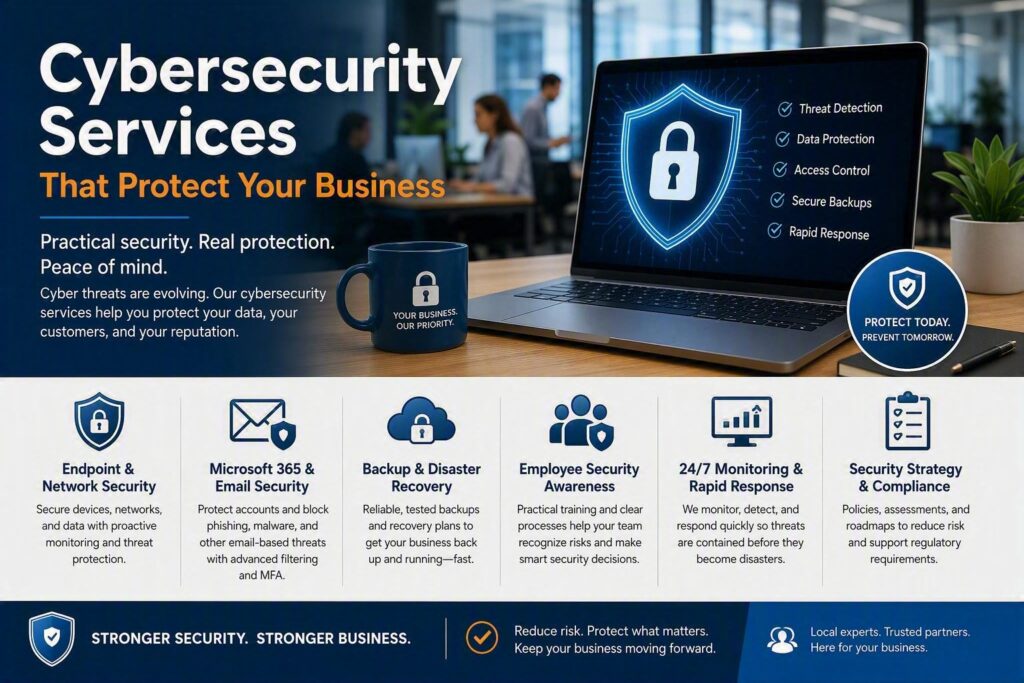
Cybersecurity is not a single product that you install and forget. Effective protection combines technology, monitoring, employee awareness, policies, backups, and ongoing maintenance.
Device and Network Security
Every computer, server, mobile device, wireless network, and internet connection contributes to your organization’s overall security.
Business devices should have:
Current operating system and software updates
Professionally managed antivirus and threat detection
Secure configurations
Appropriate user permissions
Protection against unauthorized access
Regular security monitoring
Networks should also be properly configured and segmented. For example, guest Wi-Fi should not provide an easy path into internal business systems.
Much of this work happens quietly in the background. That can make it easy to overlook when everything is working normally. However, outdated software, unsupported devices, and poor configurations can create opportunities that attackers actively look for.
Proactive cybersecurity maintenance is generally less disruptive than emergency recovery after an attack.
Microsoft 365 and Email Security
Email continues to be one of the most common entry points for cybercrime. Attackers may send fake invoices, password-reset requests, voicemail notifications, or messages that appear to come from a manager, customer, or vendor.
Modern phishing attacks can be convincing, professionally written, and highly targeted.
One of the most effective ways to protect business accounts is multi-factor authentication. With MFA enabled, a stolen password alone is not enough to access an account.
Additional email and identity security measures can include:
Suspicious login alerts
Email filtering
Strong password policies
Account access controls
Protection against malicious links and attachments
Restrictions on automatic email forwarding
Regular review of user accounts and permissions
These protections are particularly important for organizations using Microsoft 365 for email, file sharing, collaboration, and daily business operations.
There is a balance to maintain. Security controls that are too restrictive can frustrate employees and interfere with legitimate work. Controls that are too relaxed can leave sensitive accounts vulnerable.
The best cybersecurity strategy makes secure behavior the easiest behavior while giving employees clear guidance when they need help.
Backup and Disaster Recovery
A backup is one of the most important components of a cybersecurity strategy, but simply having a backup does not guarantee that your business can recover.
Organizations should know:
What data is being backed up
How frequently backups run
Where backup copies are stored
How long backups are retained
Who is responsible for monitoring backups
How quickly critical systems can be restored
A strong backup strategy should include protected backup copies that attackers cannot easily encrypt or delete.
Backups should also be tested regularly. Discovering that a backup is incomplete or unusable during a ransomware attack is far too late.
A comprehensive recovery strategy should account for more than files. Businesses may also need to restore:
Email
Cloud data
Business applications
Servers
Network equipment
User accounts
Critical systems and services
Disaster recovery planning should also address how the organization will continue operating while systems are unavailable.
Employee Cybersecurity Training
Even the best technology cannot eliminate every cybersecurity risk.
Employees need practical, relevant training that helps them recognize suspicious messages, identify unusual requests, and report potential security incidents quickly.
The goal is not to blame someone for clicking the wrong link. The goal is to create a workplace where employees feel comfortable reporting mistakes and suspicious activity immediately.
Fast reporting can make a significant difference. A compromised account or suspicious email may be contained before it develops into a larger incident.
Businesses should also establish clear procedures for common security situations. For example:
Verify payment changes using a known phone number rather than replying to an email.
Remove access promptly when employees leave the organization.
Know who to contact when a device is lost.
Report suspected password compromises immediately.
Give employees a clear process for reporting suspicious emails.
Good cybersecurity combines technology with clear, repeatable processes.
How to Choose the Right Cybersecurity Services
The right cybersecurity provider should begin by understanding your business rather than immediately offering a generic package.
Ask questions such as:
Which systems would cause the greatest disruption if they went offline?
What information would be most damaging to lose or expose?
Who has access to financial, customer, or health-related information?
Are employees working remotely?
Are employees using personal devices?
Which systems are connected to the internet?
How quickly could the business recover from a major outage?
A security assessment can turn those answers into practical priorities.
For one organization, the most urgent improvement may be Microsoft 365 security and multi-factor authentication. For another, it may be replacing an unsupported server, securing remote access, or fixing unreliable backups.
Trying to address every possible cybersecurity issue at once can strain a budget and overwhelm employees. A phased security plan often delivers better results, provided the most serious risks are addressed first.
What to Look for in a Cybersecurity Provider
A good cybersecurity provider should be able to explain recommendations in plain language.
You should understand:
What is being monitored
Which security tools are being used
What happens when an alert is triggered
Who is responsible for responding
How quickly support is available
How security improvements will be prioritized
How cybersecurity fits into your overall IT strategy
A monthly report can be useful, but having an experienced person who can respond when a genuine security incident occurs is even more valuable.
For organizations in Chilliwack and throughout the Fraser Valley, working with a managed IT partner can also bring cybersecurity together with everyday IT support, cloud services, network management, and technology planning.
This integrated approach helps prevent cybersecurity from becoming a separate project that does not reflect how employees actually work.
Signs Your Business Cybersecurity Needs Attention
Cybersecurity problems do not always begin with a dramatic ransomware message. Often, the warning signs appear during everyday business operations.
Watch for issues such as:
Repeated password-reset requests
Unfamiliar login notifications
Unexpected email forwarding rules
Unexplained computer performance problems
Unsupported software or hardware
Failed or inconsistent backups
Unusual account activity
Employees receiving suspicious emails that appear to come from coworkers
There are also organizational warning signs.
If nobody knows who has administrator access, former employees may still have active accounts, or employees are unsure what to do with suspicious messages, your organization may have a cybersecurity process gap.
If a critical system fails and there is no documented way to restore it, that is a business resilience gap.
A professional security review can identify these weaknesses without assuming the worst. The objective is to understand your current security posture, prioritize the most important vulnerabilities, and create a realistic plan for improvement.
Cybersecurity Is an Ongoing Process
Cybersecurity cannot be treated as a one-time project.
Threats evolve. Software changes. Employees join and leave. Cloud applications are added. Devices are replaced. Vendors receive access to systems. Businesses change the way they work.
Your security strategy needs to keep pace.
Regular software patching, security monitoring, account reviews, backup testing, access management, and employee training can significantly reduce risk over time.
When an incident does happen, a documented incident response plan and responsive technical support can reduce confusion and help decision-makers act quickly.
Protect Your Business With Practical Cybersecurity Services
Strong cybersecurity does not have to make your business complicated or difficult to operate.
The best security strategy is one your team can understand, follow, and maintain while continuing to focus on the customers, clients, patients, donors, and communities you serve.
Myriad Technologies understands that technology problems become business problems when they interrupt your day, expose sensitive information, or put your organization’s reputation at risk. Practical cybersecurity services can help reduce those risks while keeping security aligned with the way your organization actually works.
A good place to start is by identifying the one system, account, or type of data your organization could least afford to lose access to.
Ask how it is currently protected. Ask how it would be recovered after an attack or outage. Then use those answers to guide your next cybersecurity improvements.