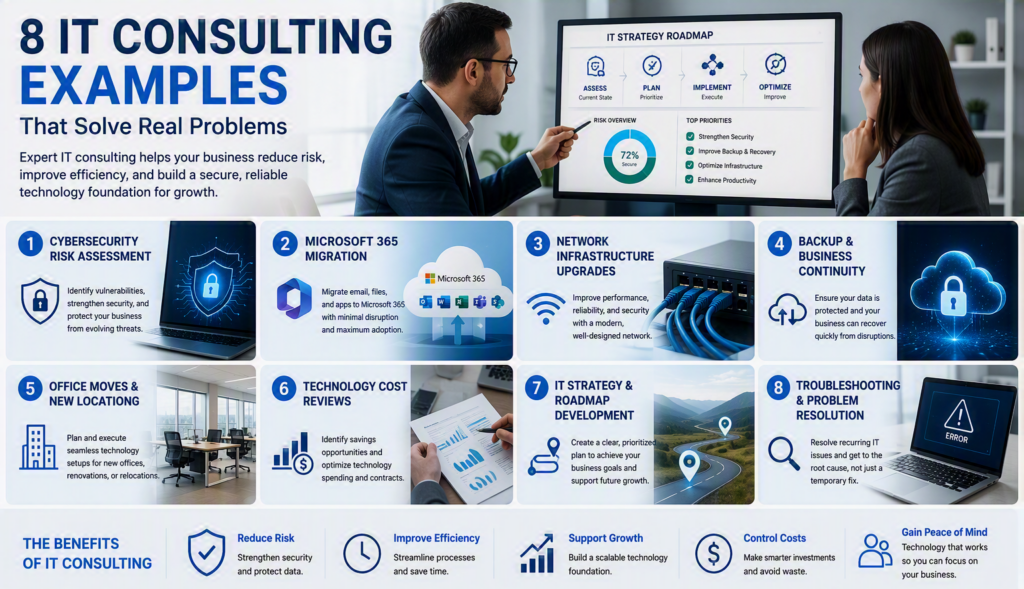
Technology problems rarely happen at convenient times. A server can fail before the workday begins, a phishing email can reach every employee in minutes, or an office relocation can reveal technology requirements that were never properly planned. These situations highlight why IT consulting services are about more than fixing computers. They help businesses reduce risk, improve efficiency, and make informed decisions before small issues become costly disruptions.
For small and midsize businesses, IT consulting can range from a one-time project to ongoing strategic guidance. The right consultant helps align technology with business goals, ensuring that every investment supports productivity, security, and future growth.
What Does IT Consulting Actually Do?
Effective IT consulting starts with understanding your business. A consultant should learn how your team works, identify your biggest technology challenges, and evaluate which systems are critical to daily operations.
Rather than overwhelming decision-makers with technical jargon, a good IT consultant provides practical recommendations that improve security, reliability, and productivity.
Some organizations need immediate assistance with a pressing issue. Others need a long-term technology roadmap. In either case, the goal is the same: helping the business make smarter technology decisions.
1. Cybersecurity Risk Assessments and Security Planning
One of the most valuable IT consulting services is a comprehensive cybersecurity assessment.
Many businesses have basic protections in place, such as antivirus software and passwords, but still have significant vulnerabilities, including:
- Shared user accounts
- Weak password policies
- Missing multi-factor authentication
- Outdated hardware and software
- Untested backups
- Inadequate employee security training
A cybersecurity consultant identifies these risks and prioritizes them based on urgency and potential impact.
The outcome should include a practical action plan, such as:
- Securing privileged accounts
- Implementing MFA
- Protecting business email
- Testing backup systems
- Applying security updates
- Training employees to recognize phishing attempts
The most effective security strategies balance protection with usability so employees can remain productive without unnecessary restrictions.
2. Microsoft 365 Migration and Cloud Transformation
Many organizations continue to rely on outdated file servers, legacy email systems, or employee-created cloud storage solutions.
A Microsoft 365 consulting project can consolidate:
- Calendars
- File storage
- Microsoft Teams
- SharePoint
- OneDrive
- Identity management
Before migrating, an IT consultant reviews:
- User accounts
- Mailboxes
- File permissions
- Shared resources
- Device compatibility
- Security settings
Successful migrations involve more than transferring data. User training, adoption support, and security configuration are equally important to ensure employees can work effectively in the new environment.
3. Network Infrastructure Upgrades
Slow internet is not always caused by an internet provider.
Many businesses experience poor performance because of aging:
- Firewalls
- Network switches
- Wireless access points
- Structured cabling
- Network configurations
An IT consultant evaluates the entire network environment to identify bottlenecks and security concerns.
For example:
- Healthcare clinics may require separate networks for staff, guests, and connected devices.
- Professional services firms may need stronger Wi-Fi coverage and secure remote access capabilities.
- Hybrid workplaces may require improved support for video conferencing and cloud applications.
Rather than replacing everything at once, consultants often recommend a phased upgrade plan that aligns with budgets and business priorities.
4. Business Continuity and Backup Planning
Many organizations assume backups are working until they actually need them.
A professional IT consulting engagement can assess:
- Backup coverage
- Recovery times
- Backup testing procedures
- Cloud storage options
- Disaster recovery readiness
- Ransomware protection
Consultants help businesses answer critical questions:
- How quickly can operations resume after a failure?
- How much data can be lost before it impacts the business?
- Are backups protected from cyberattacks?
- Has recovery been tested successfully?
The focus should not simply be on having backups but on ensuring the organization can recover quickly and confidently when disruptions occur.
5. Office Relocations and New Office Technology Planning
Moving offices involves much more than transporting computers and desks.
Technology considerations often include:
- Internet connectivity
- Structured cabling
- Wi-Fi design
- Phone systems
- Conference room technology
- Security systems
- Network infrastructure
Without proper planning, opening day can result in unexpected delays and operational disruptions.
An IT consultant coordinates technology requirements with:
- Internet service providers
- Building managers
- Contractors
- Electricians
- Security vendors
This planning ensures the new space supports both current operations and future business growth.
6. Technology Cost Reviews and Vendor Management
Many businesses unknowingly pay for:
- Duplicate software subscriptions
- Unused cloud services
- Legacy support agreements
- Unnecessary telecom services
- Underutilized licensing plans
An IT consulting review compares technology expenses against actual business needs.
The goal is not always to cut costs. Instead, consultants help organizations invest in technology that delivers value while eliminating services that no longer support business objectives.
These reviews are particularly useful during annual budgeting cycles, mergers, acquisitions, or periods of rapid growth.
7. Strategic IT Roadmaps and Technology Planning
One of the most common challenges businesses face is knowing where to start.
Organizations often have:
- Aging computers
- Security concerns
- Network issues
- Capacity limitations
- Budget constraints
- No clear upgrade schedule
An IT roadmap transforms a lengthy list of concerns into a structured plan.
A roadmap may identify:
- Immediate security priorities
- Projects for the next six months
- Equipment replacement timelines
- Cloud migration opportunities
- Infrastructure upgrades
- Long-term technology investments
For example, a roadmap may prioritize replacing unsupported software before planning a future server replacement.
By creating a structured plan, businesses can budget effectively and avoid reacting to unexpected technology failures.
8. Troubleshooting Recurring Technology Problems
Not every consulting project involves large-scale upgrades.
Sometimes organizations need expert assistance to solve persistent problems such as:
- Email delivery issues
- Network instability
- Cloud application performance problems
- Remote access failures
- VoIP call quality issues
- Software crashes
Instead of applying temporary fixes, an experienced consultant investigates the root cause.
This often involves:
- Reviewing system logs
- Testing network performance
- Examining device health
- Interviewing users
- Analyzing recent system changes
The final recommendation should clearly explain:
- Why the issue occurred
- What was done to resolve it
- How future occurrences can be prevented
How to Choose the Right IT Consulting Service
Before contacting an IT consultant, clearly define the business impact of the issue.
For example:
Less helpful:
“Our Wi-Fi is slow.”
More helpful:
“Employees regularly lose access to our cloud applications, causing delays in customer service.”
This context helps consultants understand urgency, identify root causes, and recommend the appropriate solution.
When evaluating consultants, ask:
- What does the assessment include?
- Who will perform the work?
- How are findings presented?
- Are recommendations prioritized?
- Is implementation included?
- Will ongoing support be available?
A consulting partner should provide clear communication, practical recommendations, and solutions aligned with business goals rather than promoting unnecessary products or services.
Why IT Consulting Is Worth the Investment
The best IT consulting engagements prevent costly problems before they happen.
Whether you’re improving cybersecurity, migrating to Microsoft 365, upgrading your network, planning an office move, or creating a long-term technology strategy, professional consulting provides the expertise needed to make confident decisions.
For organizations across the Fraser Valley, Myriad Technologies helps businesses transform technology challenges into manageable projects through strategic guidance and professional IT consulting services.
The best time to seek IT consulting is before an emergency forces a rushed decision. Start with the technology issue creating the most uncertainty in your business and build a plan that turns technology into a competitive advantage instead of a source of stress.